Be a Trauma-Informed Agency
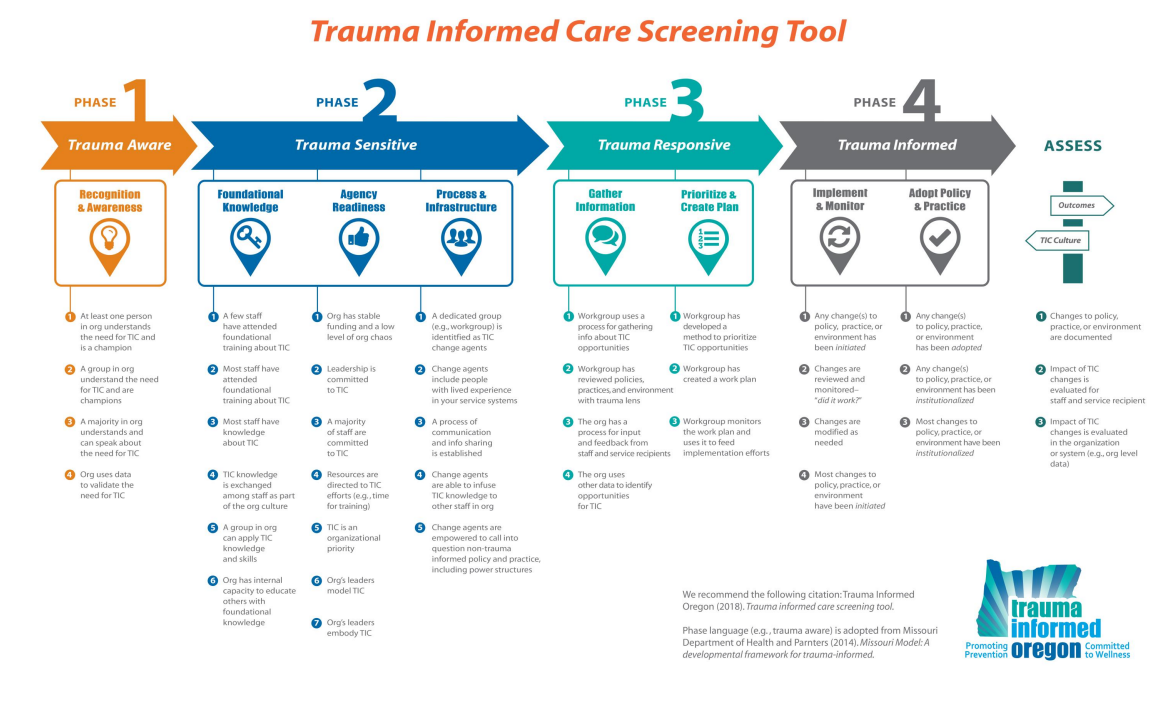
Trauma Informed Oregon Screening Tool
Phases of a Trauma Informed Agency
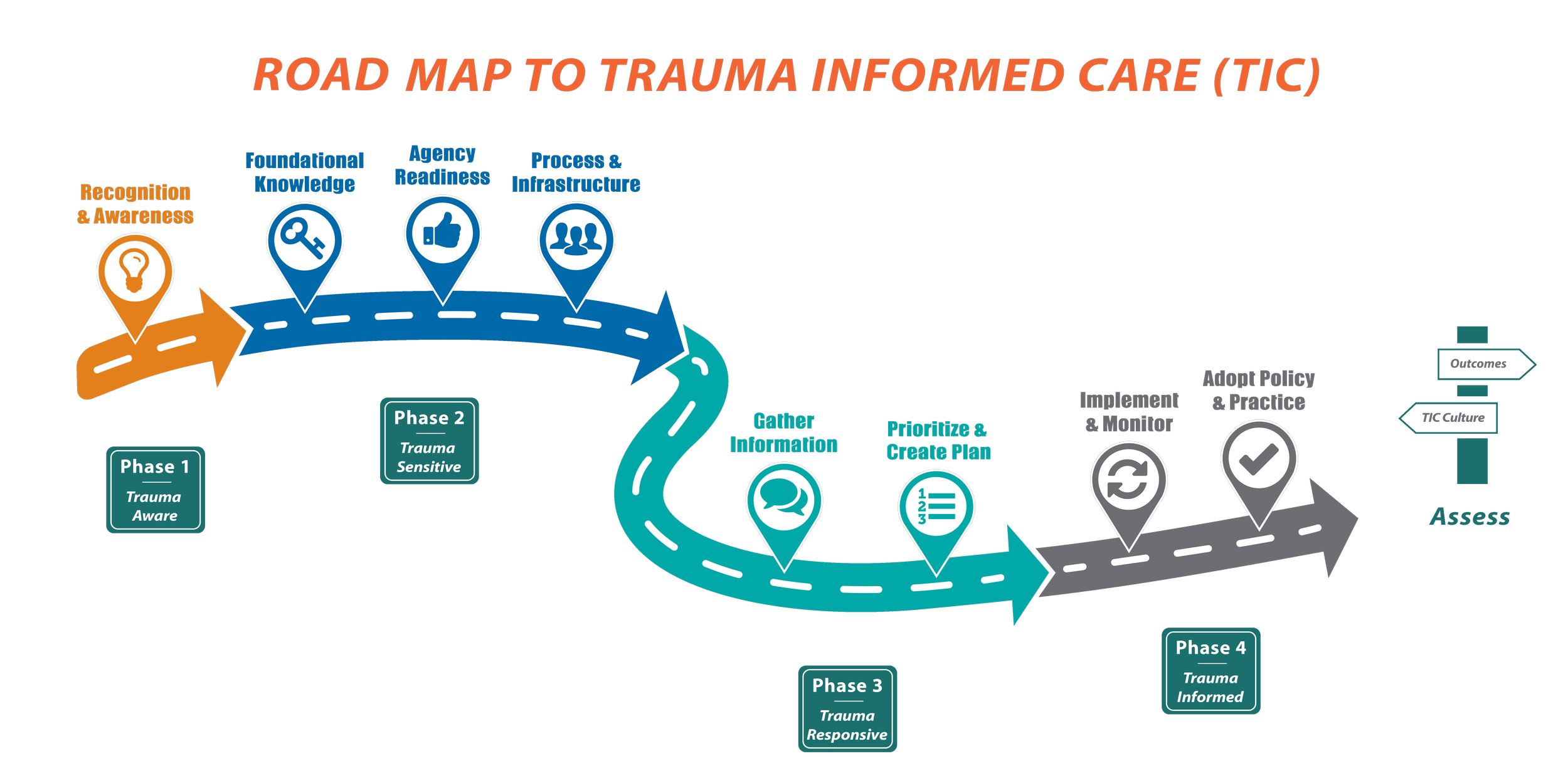
Recognition & Awareness
Foundational Knowledge
Agency Readiness
Process & Infrastructure
Gather Information
Prioritize & Create a Plan
Implement & Monitor
Adopt Policy & Practice
Source: Trauma Informed Oregon
Outcomes
TIC Culture
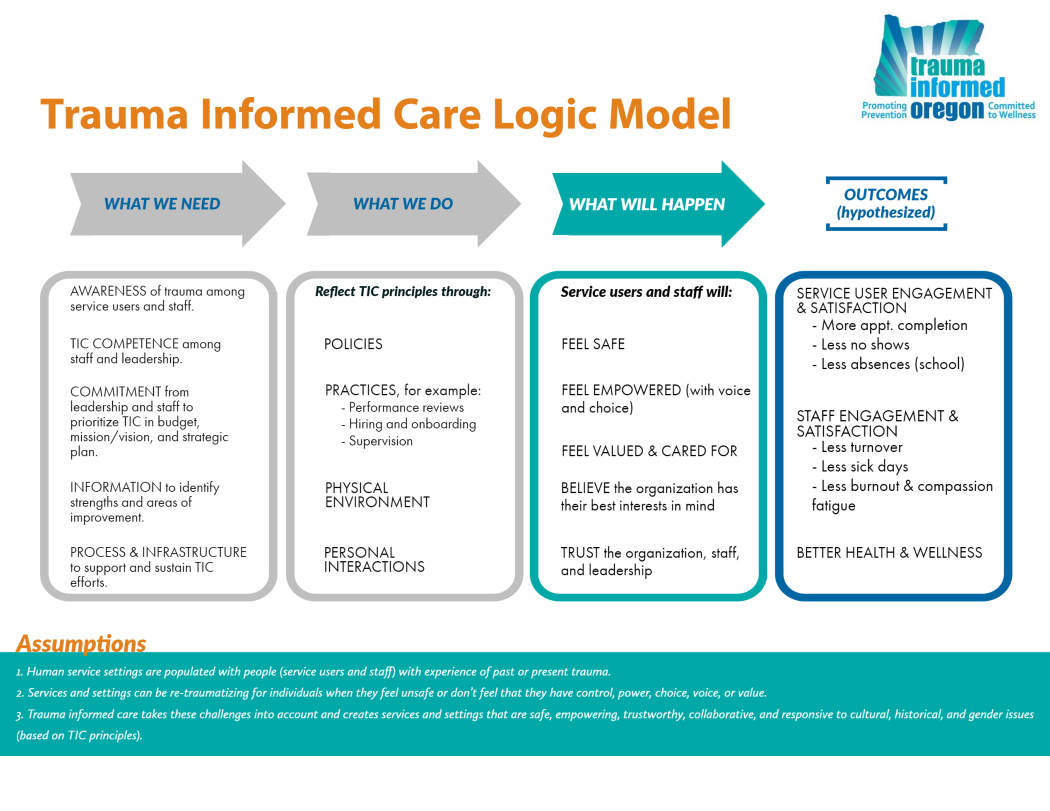
Trauma Informed Oregon TIC Logic Model
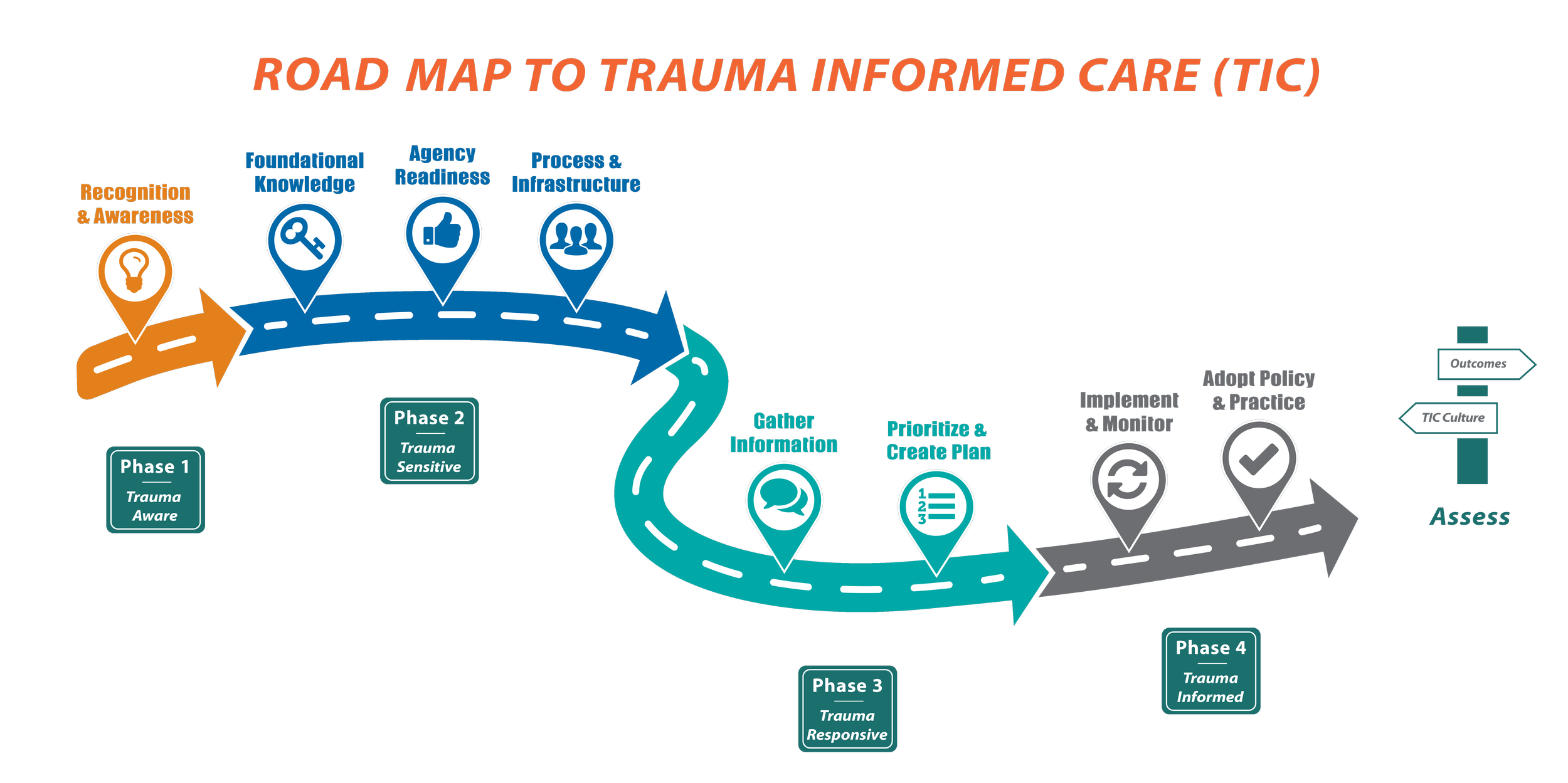
Trauma Informed Oregon Agency Roadmap
Element #1: Organizational Commitment
Organizational commitment is demonstrated through dedicated support for a trauma-informed infrastructure that includes specific funding and employee time for implementing trauma-informed care. Organizations acknowledge that an understanding of the impact of trauma is central to effective service delivery and make operational decisions accordingly. Leadership collaborates with other organizations to create a trauma-informed community that follows the principles of trauma-informed care across sectors.
Organizational commitment is evident within all four domains outlined in SAMHSA’s TIC Guidance:
Governance and Leadership
Policy
Financing
Engagement and Involvement
Element #2: Culture and Climate
Culture and climate is the cohesive narrative, the glue, that holds a trauma-informed community together. It is the embodiment of all that is seen, heard, done, and experienced in spaces and settings. Trauma-informed practices and settings demonstrate an understanding of the impact of trauma and toxic stress on the body (both individual and organizational) and the power of relationship and belonging. This understanding appears in the language used, protocols that are followed, and behaviors that are witnessed.
Element #3: Training and Education
The professional development plan for staff is demonstrated by staff competency and skills, as well as how the principles and values of trauma-informed care are applied in the training methodology. The plan’s goal is staff embodiment of the content shared. Training is paired with educational opportunities that promote competence (knowledge) and confidence (skill) to apply to trauma informed approaches (TIA). This learning is done at a reasonable pace, is role specific, and performed throughout the job cycle (Ask “who needs to know what by when?”).
Element #4: Policy, Procedure, and Practice Review
Policies and procedures offer a mechanism to sustain TIC, allowing helpful practices to flourish and evolving over time in response to feedback and growing knowledge about the field. Policies and procedures are reviewed through a TI lens with a process that defines how misalignment with TI values is handled. The process will continuously examine “who is at the table” and whose voice and experience is centered. Changes are made in areas within an organization’s locus of control. The limitation of regulatory bodies is recognized and system change is sought.
Element #5: Feedback and Quality Assurance
Feedback and quality assurance techniques are used to impact practice. Trauma-informed organizations demonstrate inclusive and effective feedback practices that solicit how staff and service recipients feel and experience the organization. The feedback process is routine, multimodal, and centers those most impacted by the work. The feedback received and plans for practice change are shared. These processes demonstrate knowledge about the impacts of trauma in the organization’s methods, language, how the feedback that is sought, and how the information is used.
Source: Trauma Informed Oregon